How to Choose the Best Card Machine for Small Business
How to Choose the Best Card Machine for Small Business

The best card machine for a small business is the one that fits how you take payments and what you pay to accept them. A low-cost terminal can still come with expensive transaction fees. A lower transaction rate may be offset by monthly charges, minimum fees or a long contract.
Before you choose, compare the full cost, check that the hardware suits your setup and find out exactly when you’ll receive your money. Here’s a practical guide for Irish businesses, from sole traders and local shops to growing merchants processing €1 million to €5 million in card payments each year.
Start with how your business takes payments
A terminal should fit the way you serve customers, not force you to change a working setup. Think about where payments happen, how busy your busiest periods get and whether the machine needs to connect to your till or other business software.
| Terminal type | Often suits | Check before choosing |
|---|---|---|
| Countertop or till terminal | Retail counters, pharmacies, GP surgeries and reception desks | Connection to your till, receipt options and space at the counter |
| Portable terminal | Restaurants, cafés, bars and businesses taking payments across a premises | Wi-Fi or mobile signal, battery life, tipping and split-bill features |
| Mobile terminal | Tradespeople, taxis, market stalls, events and other businesses on the move | Mobile data, coverage, charging and how receipts are sent |

Some portable terminals come with their own SIM connection; others depend on Wi-Fi or pair with a phone. If you take payments in a taxi, at a market or at a customer’s home, check that the setup works away from your premises. If you mainly serve customers at a fixed till, a countertop machine may be simpler.
For a restaurant or bar, a portable terminal can let staff take payment at the table. A retailer may need a countertop machine that works smoothly with its point-of-sale (POS) system. The software used to record sales and manage the till. A clinic may need a reliable desk terminal, with a separate way to take deposits remotely.
See our hospitality payment solutions and healthcare payment solutions for examples of how the right setup can differ by sector.
Check which payments the machine can accept
Most businesses need to take contactless and chip-and-PIN payments. But don’t assume every terminal or merchant account accepts every card type under the same terms.
Ask the provider whether the setup supports:
- Contactless, chip-and-PIN and mobile wallets such as Apple Pay or Google Pay
- The debit and credit cards your customers commonly use
- Business, premium or cards issued outside Ireland and the EEA
- Foreign-currency payments, if you regularly serve international customers
Multi-currency can mean different things. A terminal may accept a customer’s card when it’s issued abroad, while the transaction still settles to you in euro. Charging a customer in another currency or receiving settlement in that currency are separate features. Ask how exchange rates and any conversion charges work, and what happens with refunds.
Compare the full cost, not just the rate
A provider might quote a percentage of each sale, a fixed charge per transaction, a monthly terminal fee, or a combination. Some published plans are pay-as-you-go; others include a monthly fee or different rates depending on the card. For examples of how providers present their pricing, see Square’s Ireland pricing, SumUp’s Ireland pricing and Revolut Terminal. Check the current offer and full terms directly with each provider before deciding.
To compare quotes, work out:
Monthly terminal or software costs + transaction fees + fixed per-payment charges + any other applicable fees.
Then check for charges that might sit outside the headline rate:
- Minimum monthly service charges
- Authorisation fees: the charge for processing a payment
- PCI or compliance fees
- SIM, connectivity, receipt-paper or equipment costs
- Refund, chargeback or currency-conversion fees
- Setup fees, contract terms and early-exit charges
If your average sale is small, a fixed charge on every transaction may matter more than you expect. If you take a lot of card payments, even a small difference in the percentage rate can add up. Use your own card volume and transaction count to compare providers, rather than relying on a headline rate alone.
Our guide to card processing fees in Ireland explains the main fee types and what to look for on a merchant statement.
Match the machine to the way you work
The right card payment machine should make checkout straightforward for your customers and staff. Before you sign, ask how it fits with the rest of your business.
- Retail: Will payments link to your till and sales reports? Can staff use the same workflow they already know?
- Hospitality: Can staff take payments at tables? Does the system support tips and split bills?
- Healthcare: Is the terminal suited to a reception desk? Do you also need a secure way to take deposits for appointments?
- Professional services and mobile businesses: Can you take a payment on the road, or send a payment link when the customer isn’t with you?

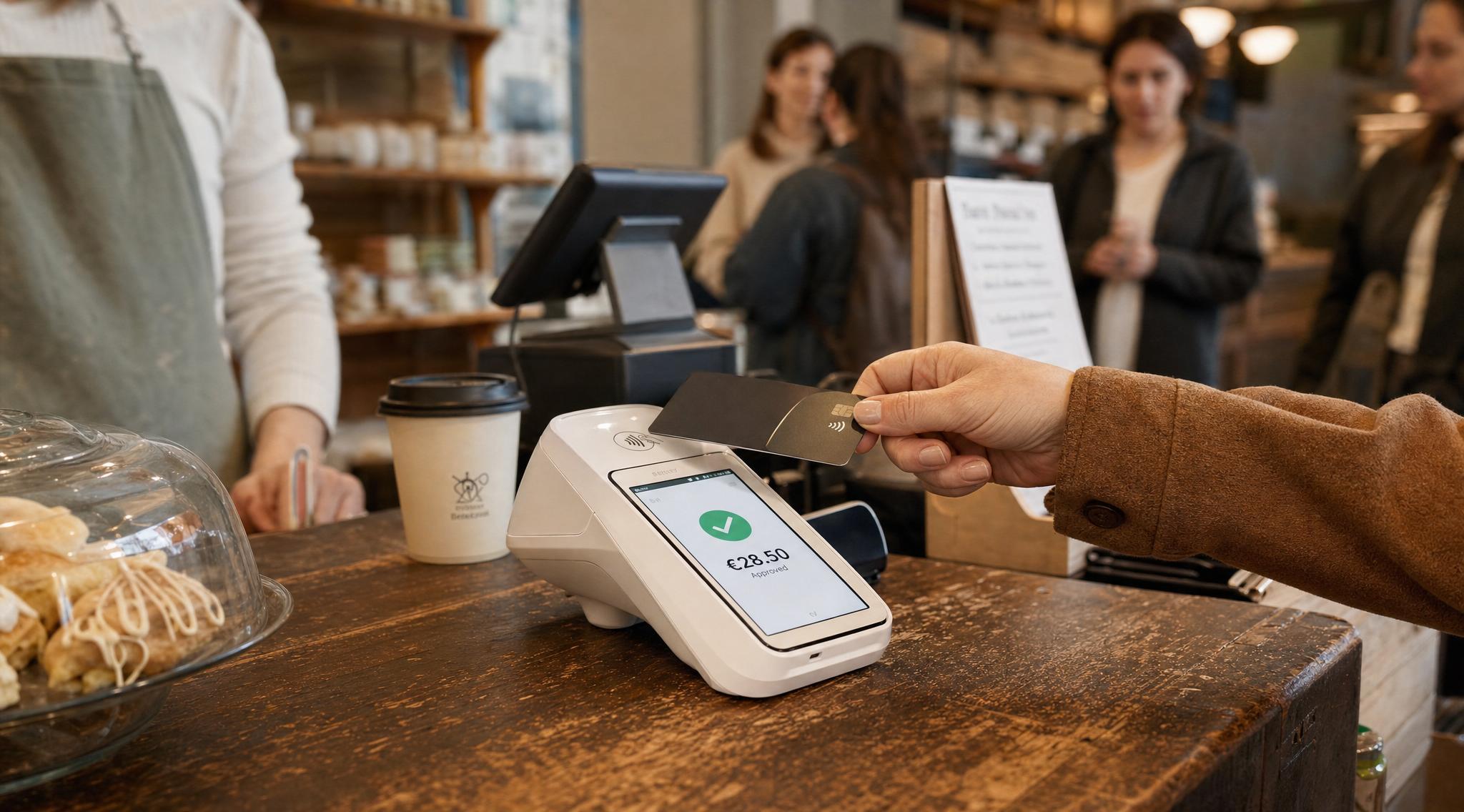
If you take payments online as well as in person, a physical terminal won’t cover everything. You may also need an online gateway or payment link for deposits, remote orders or invoices. CFS Ireland can help compare card terminals, online payments and other merchant services as part of one setup.
Ask about settlement, support and the contract
A card payment can be approved at the till before the funds reach your business bank account. Ask when settlement happens, whether weekends affect the timing and where the funds are paid. Also check what support is available if a terminal stops working during a busy shift.
Before signing, get clear answers on:
- Contract length: Is the agreement rolling or fixed-term? What notice do you need to give?
- Equipment: Are you buying or renting the terminal? What happens if it needs replacing?
- Connectivity: Does it use Wi-Fi, a SIM or both? Is mobile data included?
- Support: Who do you contact when a payment fails or the device has a problem?
- Integrations: Will it work with your till, POS, accounting or booking software?
A low monthly price isn’t useful if the machine doesn’t suit your premises or the contract is difficult to leave. Get the full costs and terms in writing, and compare quotes using the same monthly card volume and transaction count.
Get an independent comparison before you switch
The best option depends on your business, not a universal “best provider” list. A sole trader taking occasional mobile payments has different needs from a busy restaurant, clinic or retailer. A merchant processing €1 million to €5 million a year may have more room to discuss tailored pricing, but the right answer still depends on transaction size, card mix, equipment and service requirements.
At CFS Ireland, we compare options across providers rather than pushing a single acquirer. We can review your current statement, look at how you take payments and explain the costs and trade-offs in plain English. If your existing arrangement already suits you, you may not need to change it.
Where the application, paperwork and provider approval allow, we can aim for a 48-hour go-live, handling the hardware, software and banking connections. Timing depends on the provider and your circumstances, so we’ll explain what’s realistic before you commit.
Request a free rate analysis or statement review. Send us your latest merchant statement if you have it, and we’ll break down what you’re paying and whether a different card machine or payment setup is worth considering.